Free Download The Re-Justification of God: An Exegetical and Theological Study of Romans 9:10-24, by J. D. Myers
As a publication, featuring the sensible and also careful book is the basic one to constantly bear in mind. It has to select and also pick the best words options or dictions that could affect the quality of the book. The Re-Justification Of God: An Exegetical And Theological Study Of Romans 9:10-24, By J. D. Myers likewise features the very easy language to be recognized by all people. When you assume that this publication appertains with you, pick it currently. As a great publication, it offers not just the attributes of the books that we have offered.
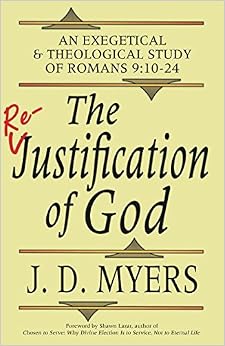
The Re-Justification of God: An Exegetical and Theological Study of Romans 9:10-24, by J. D. Myers

Free Download The Re-Justification of God: An Exegetical and Theological Study of Romans 9:10-24, by J. D. Myers
How is your time to spend the leisure time in this day? Are you starting to do a brand-new task? Will you aim to review? Everyone knows as well as concurs that reading is an excellent routine. You must review and also check out, in addition guide with numerous advantages. However, is that real? There are only couple of people who like to read. If you are among them, it is excellent for you. We will certainly give you a new book that can make your life boosted to be far better.
For everybody, if you wish to begin joining with others to check out a book, this The Re-Justification Of God: An Exegetical And Theological Study Of Romans 9:10-24, By J. D. Myers is much suggested. As well as you need to obtain guide The Re-Justification Of God: An Exegetical And Theological Study Of Romans 9:10-24, By J. D. Myers here, in the link download that we supply. Why should be here? If you really want other kind of publications, you will certainly constantly find them as well as The Re-Justification Of God: An Exegetical And Theological Study Of Romans 9:10-24, By J. D. Myers Economics, politics, social, scientific researches, religious beliefs, Fictions, as well as a lot more publications are provided. These available publications remain in the soft files.
Well, have you found the means to get the book? Searching for The Re-Justification Of God: An Exegetical And Theological Study Of Romans 9:10-24, By J. D. Myers in the book store will be possibly hard. This is a very popular book and you might have delegated buy it, meant sold out. Have you felt tired to find over again to guide stores to know when the local time to obtain it? Now, see this site to get what you require. Right here, we won't be sold out. The soft data system of this publication really assists everybody to obtain the referred publication.
Well, to obtain this book is so simple. You can save the soft documents of The Re-Justification Of God: An Exegetical And Theological Study Of Romans 9:10-24, By J. D. Myers kinds in your computer system gadget, laptop, or even your gizmo. It becomes several of advantages to extract from soft data publication. Guide is supplied in the link. Every site that we give here will certainly consist of a link and also there is exactly what you can discover guide. Having this book in your tool end up being a few of exactly how the innovative modern technology now develops. It indicates that you will not be so challenging to locate this of publication. You could search the title and also any type of subject of reviewing book here.
Review
This is one of the best books on divine election I have read. It is not overly technical or complicated, and it provides clear biblical truth about how election works, why God elects certain people and groups, and how you and I can apply the doctrine of election to our own lives.-Keith Giles, author of Jesus UntangledIf you are a serious Bible student, you should read this book. Reading it will broaden your horizons. You'll see there are more options on the table than what you will typically hear from Calvinist or Arminian writers. You'll learn to be a more careful interpreter of God's Word. And you might come away with a greater assurance that you, too, are chosen to serve Him. -Shawn Lazar, author of Chosen to Serve
Read more
From the Author
I know the cover design is terrible... But that's because I patterned it after a similar book with a similar cover and a similar title by a different author. You can use the "Look Inside" feature on Amazon to read the Preface and find out more.This book will hopefully get expanded in a future time to a much longer and more detailed look at Romans 9-11. But since I have about fourteen books in line before that book, I wanted to put this book out now so that people can have a basic understanding of an alternative way of reading Romans 9.
Read more
See all Editorial Reviews
Product details
Paperback: 116 pages
Publisher: Redeeming Press (November 14, 2017)
Language: English
ISBN-10: 1939992494
ISBN-13: 978-1939992499
Product Dimensions:
5.5 x 0.3 x 8.5 inches
Shipping Weight: 7.2 ounces (View shipping rates and policies)
Average Customer Review:
4.1 out of 5 stars
17 customer reviews
Amazon Best Sellers Rank:
#490,189 in Books (See Top 100 in Books)
This is an interesting examination of Romans, chapter 9 through 11. The author's purpose is to examine the Calvinist treatment of Romans 9:10 - 24. Calvinists see affirmation of predestination, and double predestination, in these passages.These passages seem to depict God at his most nominalist and absolutist. Thus, we have God depicted as electing some - perhaps entire groups - to damnation with as much concern as a potter might elect any given piece of his work for destruction.This approach has been seen as making God into a monster. According to this view, a loving God grants existence to some solely for the purpose of sending that lovingly created creation to the worst fate imaginable. Even worse, this fate has been predestined before time began and there is nothing that the purpose could have done to avoid this fate.Author J.D. Myers' point is to examine that perspective. His thesis is that Calvinists are misreading Romans by assuming that Paul is talking about salvation. Meyers makes a compelling point that Paul is talking about "election to service," rather than election to salvation.Myers opens with the by now uncontroversial point that Paul was not talking about individuals in Romans as most modern Christians assume. (Actually, Myers makes a "both/and" point - Paul's discussion cannot be limited to either groups or individuals; it applies to both.) According to Myers, Paul's argument is that the Jews were called to serve God as the way of bringing God to the world, but that now God has chosen to include the Gentiles into that role. Paul argues that God obviously has the right to decide how he wants to redeem the world and no one has a right to argue about unfairness.Myers points out that all the passages about the older brother serving the younger involve service, not salvation. He also points out that a non-election to service does not mean that a person so "non-elected" would be unsaved. This seems to resolve the quandary of the Jews in that Paul both affirms that the promises to the Jews are perpertual but that the gentiles seem to have been grafted on to Israel, and some Jews cut off, only to be regrafted on again at a later time. That treatment, to me, always seemed fairly inconsistent with respect to the Jews who had been cut off as long as being cut off meant loss of individual salvation. Myers writes:"For example, Paul writes in Romans 11:17-21 that the elect branches were cut off so that non-elect branches could be grafted in, which in turn will lead to the elect-which-became-non-elect to be re-grafted back in and become re-elect. If Paul is referring to eternal life when he speaks of election, none of this makes any sense. How can a people or a nation whom God elected “to eternal life†before the foundation of the world go from being elect to non-elect and then re-elect? However, this makes perfect sense when we recognize that election is not to eternal life but to service. God wants to bless the world through His people, and if one group of people fails in this God-given task, then God will simply find someone else to do it while He continues to lead the first group to fulfill His overarching purposes—albeit in different ways than originally intended. If this second group also fails, they too will be moved into an alternative role in accomplishing God’s will (Rom 11:17-21). If necessary, God could raise up a people for Himself from rocks (Matt 3:9). In this way, when Paul writes about branches being cut off so others can be grated in which will lead to the cut off branches being grafted back in again, he is not talking about people losing and regaining eternal life, but about losing and re-gaining places of privilege and purpose in God’s plan for this world. God’s plan of redemption started with Israel, shifted to the Gentiles, and eventually will reincorporate Israel so that “of Him and through Him and to Him are all things†(Rom 11:36)."Salvation - individual and corporate - seems like a big deal. On the other hand, the function of reconciling the world to God, although a big deal, seems like responsibility more than a privilege. The responsibility is now on the Church; in the past it had been on Israel; in the future, it will be on both the Church and Israel.Myers also deals with various of the classic biblical tropes that are taken to indicate predestination to individual salvation. Myers points out that those examples don't refer to individual salvation, but instead they speak of service, and all parties are selected to provide some kind of service, some exalted, some not. Myers writes concerning the issue of "dishonored pottery":Paul has just shown that God’s work in this world can be accomplished by people like Esau and Pharaoh, or the nations of Edom and Egypt, that is, by those who are not God’s “Chosen People.†Paul knows that this sort of debate is not the first time it has come up in Israelite history. A nearly identical discussion took place during the days of the prophets Isaiah and Jeremiah. Isaiah prophesied that God would use the idolatrous King Cyrus to accomplish His will. When many Israelites were indignant that God might raise up a foreign ruler to carry out His will, Isaiah reminded them that God was like a potter who could make whatever He wanted from clay (Isa 54:9). A similar discussion took place during the days of Jeremiah. In Jeremiah 18, we read that God is like a potter who can make whatever He wants from a lump of clay. It is to these sorts of historical discussions that Paul refers in Romans 9:21-24. Western theology has committed a terrible disservice to this imagery of a potter and clay by making it seem as if God is a deterministic puppet master up in heaven pulling the strings of people and nations down here on earth. This is exactly the opposite of what Isaiah, Jeremiah, and Paul meant by using this terminology. In Jeremiah 18, for example, while God is equated with the potter, God calls upon Israel to turn from her wicked ways and obey His voice so that they, as the pot which God is fashioning, will not be marred (cf. Jer 18:8-11). God calls upon Israel to come into conformity to the work of His hands. If they do not, they will become marred, and He will have to reform the clay again into another vessel (Jer 18:4). He does not destroy or discard the clay; He simply forms it into another pot which will be used for a different purpose. A similar understanding is seen in Isaiah 54 and Romans 9."This is a short, accessible book. If you are interested in the subject, it makes for an efficient and useful introduction.PSB
A lot of thought provoking content presented in this book. Really makes you view scripture in a different light and discover the love of God by explaining difficult passages.
I loved this book! It made me cry and fall in love with God all over again. Romans is one of my favorite books, but now my eyes have been opened to what Paul was really saying. I knew in my heart that God was the good guy, but J. D. Meyers provided the analysis to prove the text. I have been examining all the 'proofs' about reformed theology because I was attracted to the message, but couldn't go all the way down the Tulip path, because it did not resonate in my heart that God who is Holy would love imperfectly. I believed Holy trumped Sovereignty, yet, I believe in the sin message, wrath of God, the Gospel and Jesus and decided that I was a "middle of the road" person caught between two big Theologies (the Big C and A). Now, I get it. I can with great confidence read the difficult chapters of Roman, and my furrowed brow is eased. Thank you J. D. Myers. I love God, even more and am so grateful that his is so longsuffering in his perfect love! Well done.
I've been a follower of Christ for 25 years and I am only now understanding the richness of God's love for us - all of us. He has, is, and will be relentless in His pursuit for us. He hasn't given up on those who are rebelling against Him; and, He won't give up on we who have come to Him by faith. We acknowledge our sin and our need, we confess that Jesus is Lord, and we believe that He paid the penalty for our sin, once and for all. This is the good news: that if we believe this, we have eternal life. This is what Jesus calls all men to believe.With this in mind, the more I revisit the scriptures, the more I see that the same patterns come up time and time again. God relentlessly pursues us and places blessings and trials in our way to win us over. Israel was chosen for that purpose, as was Egypt. Similarly, individuals are chosen for this service, whether they be like Jacob or Esau, or Pharaoh. God is prepared to make use of men and nations that He might reconcile to Him as many as who would believe in Jesus.This is what J.D. Myers presents in "The Re-Justification of God." He explains that in Romans 9, Paul is making a case that the Church needn't despair about the trials that the Jewish nation was about to suffer. They needn't worry that God reneged on his promises and commitments and covenants with Israel. In his book, Myers highlights that in the Epistle to the Romans (Chapters 9 thru 11), the Apostle Paul emphasizes that God is faithful in keeping His promises and that He uses some pretty creative means to do so - like blessing the Church (Jews and Gentiles) with primacy in delivering God's gospel of grace to the world. He shows how Paul argues that the goodness God demonstrates in the Church serves the purpose of calling the Jewish nation to repentance and faith in their Messiah. Since God hasn't given up on redeeming Israel, God will not give up on seeing the Church's redemption through to completion: "He who began a good work in you will carry it on to completion until the day of Christ Jesus" (Philippians 1:6).God is good and He is faithful and He longs to be with us in eternity - all of us, if we would only believe.
A great book that has challenged me in how I read Romans 9-11. I highly recommend this book.
Excellent book with a very interesting and logical perspective on Romans 9: 10-24 - well thought out and well written. Great job pushing back on the was has become over time the more traditional and accepted Calvinist perspective. The bottom line is we need to constantly challenge and learn - we still have a lot we don't know.I've read other books on Paul's letters and other books by J.D. Myers and I feel this is a must read for fans of either (or both).
I feel the author has spiritual insight to scripture and helps to explain things. I would recommend any of his work!! :)
The Re-Justification of God: An Exegetical and Theological Study of Romans 9:10-24, by J. D. Myers PDF
The Re-Justification of God: An Exegetical and Theological Study of Romans 9:10-24, by J. D. Myers EPub
The Re-Justification of God: An Exegetical and Theological Study of Romans 9:10-24, by J. D. Myers Doc
The Re-Justification of God: An Exegetical and Theological Study of Romans 9:10-24, by J. D. Myers iBooks
The Re-Justification of God: An Exegetical and Theological Study of Romans 9:10-24, by J. D. Myers rtf
The Re-Justification of God: An Exegetical and Theological Study of Romans 9:10-24, by J. D. Myers Mobipocket
The Re-Justification of God: An Exegetical and Theological Study of Romans 9:10-24, by J. D. Myers Kindle